By Sam David
UpScrolled, a social media platform for microblogging and short-form video sharing, experienced rapid growth in late January 2026 following disputes surrounding TikTok’s US operations. The expansion was initiated largely by allegations that protest-related content was being suppressed on mainstream platforms and, while independent verification of this is limited, the perception of such appears to have been sufficient to drive migration. UpScrolled grew quickly into a high-traffic alternative space framed around resistance to perceived censorship.
In the weeks following, UpScrolled hosted substantial volumes of lawful political discourse. Users debated domestic immigration enforcement, ongoing and emerging international conflicts, free speech, and related issues. Alongside this content, however, monitoring identified significant presence of material supportive of designated terrorist and violent extremist (TVE) movements, as well as identity-exclusive and conspiratorial narratives.
The emergence of this content on UpScrolled is not unique as both TVE material and lawful-but-awful discourse is detectable on most large platforms. The central issue in the UpScrolled migration is its sustained proximity to legitimate civic grievance discourse within a rapidly expanding and lightly moderated environment.
Platform Migration and Content Proximity
Observed activity suggests a pattern of narrative adjacency rather than dominance by TVE content. Discourse largely focused on lawful protest issues—such as immigration and foreign policy, policing practices, and civil liberties—but frequently contained parallel or downstream comments utilising language or imagery drawn from TVE frameworks (Figure 1). In some cases, TVE-coded discourse was embedded within conspiratorial and identity-exclusive narratives and tropes; for example, content employed TVE (neo-nazi, jihadist) terminology and imagery within conspiratorial and identity-exclusive narratives and tropes (antisemitism/anti-Zionism). In others, explicit TVE material—namely Islamic State and al-Qaeda aligned media outlets—appeared adjacent to protest content via discover feeds, shared hashtags, or through single accounts that alternated between lawful political commentary and amplification of extremist material.
It is stressed here that there is no evidence of coordinated alignment between protest communities and TVE groups or organisations. Rather, the dynamic appears opportunistic. Malign actors seeking to advance violent, exclusionary, or accelerationist narratives appeared to position themselves within high-visibility grievance streams, where discourse related to institutional distrust and systemic degradation was elevated but still lawful and legitimate (Figure 2).
This distinction is analytically significant. The findings do not suggest or support claims that lawful political or protest movements are inherently extremist, rather that periods of heightened institutional distrust generate discursively porous information environments vulnerable to exploitation by TVE groups or informal support networks. This is exacerbated when moderation is uneven and growth is rapid, and creates permissive conditions for content that would otherwise remain marginal to circulate within mainstream spaces.
Figure 1
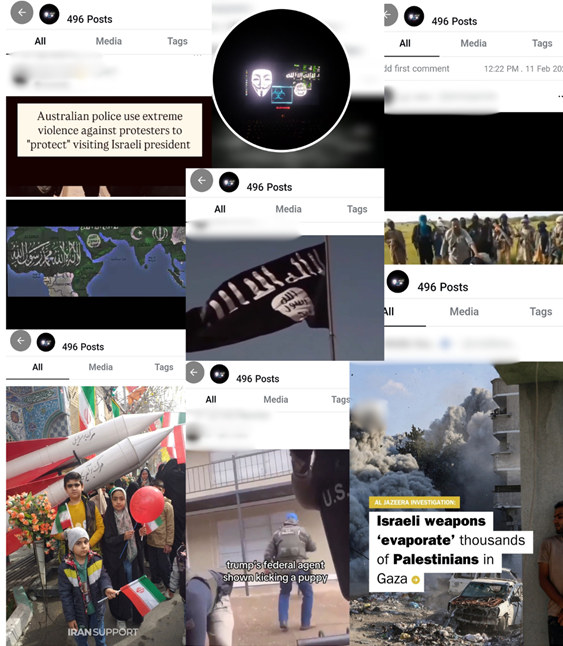
Note. Single account content collected through qualitative monitoring on UpScrolled on 10 February 2026 by Sam David. Content embedded overt TVE content (Islamic State) within broader protest discourse.
Figure 2
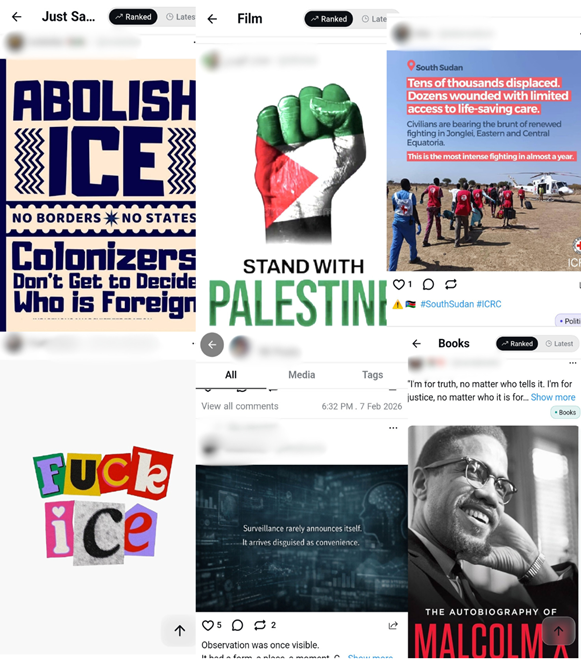
Note. Content collected through qualitative monitoring on UpScrolled between 31 January and 10 February 2026 by Sam David. Observed content was lawful and legitimate, containing elevated institutional distrust and systemic degradation narratives.
Structural Conditions
Several structural features appear to have shaped this environment. First, rapid user growth reduced the ratio of moderators to content volume. Public statements from UpScrolled leadership acknowledged capacity constraints during the surge period. In such conditions, a lag in enforcement can be expected and the presence of TVE content should not be interpreted as endorsement by the platform. UpScrolled is not alone in this struggle, both Bluesky and the Chinese-owned app XiaoHongShu (‘Little Red Book’, or ‘RedNote’) experienced similar symptoms in recent years.
Second, periods of mass digital migration can distort content visibility. When large volumes of users enter a platform simultaneously, systems are forced to adapt to incomplete behavioural data. In early-stage and rapid growth phases, mechanisms may prioritise user retention through increased volume of heterogeneous content, increasing the likelihood that ideologically divergent material appears in proximity. UpScrolled is uniquely vulnerable to this as the algorithm driving the platform’s ‘discover’ feed orders posts by engagement in conjunction with light temporal manipulation, providing a more equal opportunity to all content, be it legitimate discourse or not, to appear on a user’s feed.
Third, grievance-driven migration concentrates diverse sets of actors within the same digital space. Civil liberties advocates, geopolitical activists, and conspiracy entrepreneurs may all interpret perceived censorship as validation of broader systemic critique, placing them in close digital proximity to TVE networks and supporters. Shared distrust functions as an opportunity for lowest-common-denominator symbolic alignment, even where substantive ideological positions and tactical methods diverge sharply.
Within such an ecosystem, TVE actors do not need to dominate discourse to achieve effect. Co-location with legitimate grievance content increases the chances of exposure and, while this does not equate to audience capture or ideological alignment, it can create avenues for user harm through algorithmic radicalisation or cross-platform migration.
Exposure and Conditioning
The significance of this lies less in immediate exposure and more in downstream effects. In this context, the concern is not ideologically explicit recruitment or operational signalling; rather, it is cumulative normalisation of harmful narratives. Research has shown that narrative repetition within popular spaces can reduce the perceptual distance between issue-based mobilisation and actors seeking to instrumentalise similar grievance language for exclusionary projects. In a shifting global system, marked by compounding crises and competition across political, economic, and social domains, rising levels of institutional distrust can position individuals as more receptive to narratives and actors outside the status quo.
This does not collapse substantive distinctions in content. Lawful civic advocacy is analytically and normatively distinct from TVE movement and supporter materials. However, when context is degraded through content velocity or account-level convergence, this can produce avenues for malign digital actors to embed within the broader discourse without ideological commitment from the audience. As these exposure pathways expand, users are likely to encounter TVE-coded interpretations not through deliberate behaviour, but proximity.
Why This Matters
The case of UpScrolled illustrates that rapid migration events can introduce visibility gaps as diverse sets of user groups shift across platforms. During these periods, monitoring coverage is likely to be uneven, creating permissive conditions for TVE actors and informal support networks to embed narratives within legitimate grievance streams.
This activity complicates moderation and monitoring, particularly where detection models might rely on ideologically explicit branding or static indicators. In the contemporary online environment, characterised by a multitude of actors within a geopolitical landscape in flux, moderation thresholds are difficult to calibrate without an increase in false positives or degrading analytical precision.
Co-location also carries exposure risks. TVE content, including graphic imagery or explicit violence, appearing in proximity to legitimate political discourse increases the risk of incidental exposure to harm. Research shows the scale and psychological impact of such harm in both the research community and general population. Further study should examine how structural proximity might impact the likelihood of non-deliberate exposure to violent content, and the potential implications of such exposure for user harm.
Sam David is a Director for the Canadian Association for Security and Intelligence Studies (CASIS) Vancouver and former graduate fellowship holder in Political Science at the University of British Columbia for research in human security and conflict. His work focuses on counterterrorism and counterextremism, with emphasis on mobilisation and online radicalisation within contemporary information environments.
Photo by Madison Oren on Unsplash