By Mischa Gerrard
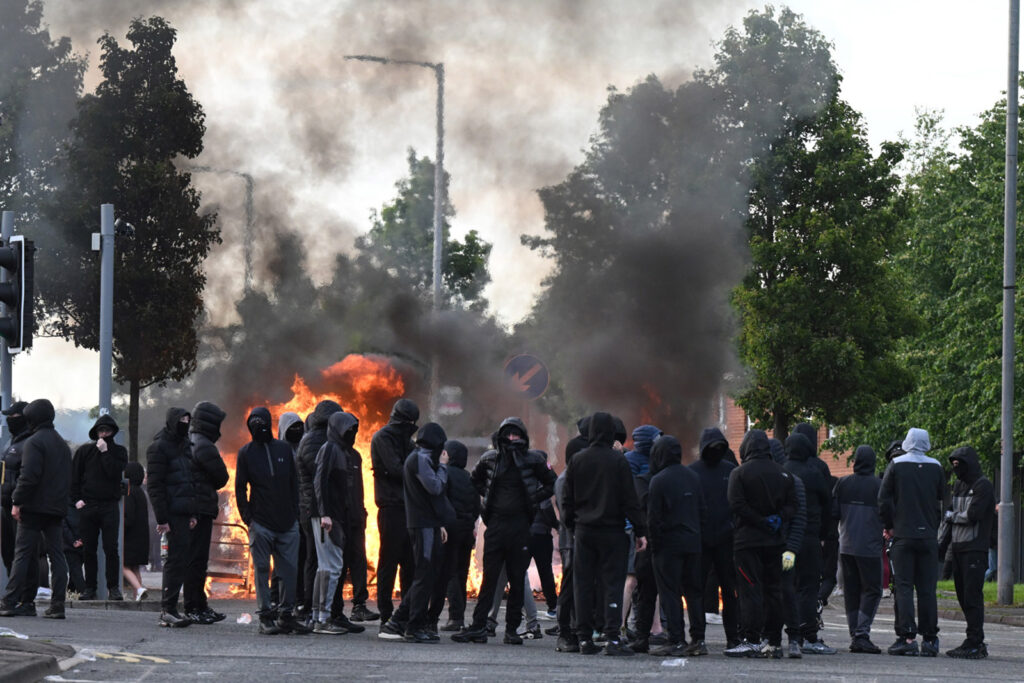
When footage of a knife attack in north Belfast began circulating online, the incident quickly escaped the confines of the street on which it had occurred. Within hours, it was being shared and debated across X, amplified by activists, influencers, and political commentators both within and beyond Northern Ireland. Demonstrations were organised, competing narratives proliferated, and disorder soon followed.
Similar dynamics have been visible following the Southport attack, the killing of Henry Nowak in Southampton, anti-asylum protests in Epping, and other recent incidents across the UK. While the catalyst events differ considerably, each has been rapidly incorporated into a broader anti-immigration narrative ecosystem where individual acts of violence become evidence of collective threat, local events become symbols of national decline, and uncertainty generates opportunities for political entrepreneurs seeking to advance pre-existing ideological claims.
What links these cases is not a common geography, ideology, or set of participants, but a recurring mobilisation process. Triggering events create information vacuums; networked actors compete to define their meaning; platform architectures amplify emotionally charged interpretations; and local incidents are transformed into increasingly transnational political flashpoints.
External Amplification and Narrative Construction
Findings from the Committee on the Administration of Justice (CAJ) provide an important insight into how these mobilisation processes operate. Examining anti-immigration disorder in Ballymena during 2025, the organisation found that local incidents were frequently amplified, reframed, and repurposed through interconnected online ecosystems that extended well beyond the communities in which events originally occurred.
Importantly, their research challenges the idea that episodes of anti-immigration disorder can be understood as spontaneous expressions of local anger. CAJ compiled evidence of ongoing online agitation, misinformation, and anti-immigration organising that predated individual incidents and persisted long after media attention had moved on. Rather than emerging in response to a single event, mobilisation was often rooted in pre-existing networks operating across Facebook, X, Telegram, TikTok and other platforms, where narratives concerning immigration, crime, housing, and cultural change were already being circulated and reinforced.
This finding is significant because it shifts attention away from individual catalyst events and towards the infrastructures within which they occur. The Ballymena riots followed allegations of sexual assault involving two Romanian-speaking teenagers, yet CAJ’s analysis suggests that the subsequent mobilisation cannot be reduced to public reaction to that incident alone. Rather, the event acted as a focal point around which existing narratives, networks, and organisational capacities rapidly coalesced.
The respective reports are equally notable for what they reveal about external amplification. In examining earlier anti-immigration protests and racist disorder, CAJ found that narratives originating outside Northern Ireland often played a disproportionate role in shaping how events were understood and represented online. During the August 2024 disturbances, social media accounts based outside the jurisdiction successfully promoted the misleading narrative that anti-immigration sentiment was uniquely capable of uniting Catholics and Protestants against a common threat, a claim capable of resonating with broader audiences and generating additional engagement.
This dynamic is strikingly visible in the latest unrest during which Northern Ireland’s Justice Minister Naomi Long criticised the disorder as being ‘stoked by those who would struggle to find the city on a map.’ Yet in a networked information environment, proximity matters less than visibility and local knowledge can be outweighed by the ability to shape narratives at scale. Research into the spread of misinformation following Southport found that highly emotive and inflammatory content was often rewarded with greater visibility, particularly when amplified by influential or verified accounts. The result is a system in which the most influential interpretations of an event are not necessarily the most accurate, but often the most emotionally resonant and politically useful.
AI, Attribution, and Verification
Recent developments suggest that generative AI may be introducing new dynamics into an already volatile informational environment. The Henry Nowak case is instructive. After footage circulated of police officers handcuffing Nowak as he lay dying, social media users and Grok wrongly identified former police officer Christi Hill as one of the officers involved, despite her having left Hampshire Constabulary more than a year before the incident. BBC Verify also found that another officer, Tristan Parsons, was wrongly accused despite evidence that he was not in the country at the time. Both were reportedly forced into hiding after receiving threats. Grok later acknowledged that it had incorrectly named Hill and made a “mistake in visual identification.”
The same pattern is visible beyond the UK. Following the fatal shooting of Renee Nicole Good by an ICE officer in Minneapolis, users reportedly asked Grok to “unmask” the officer shown in footage. The system generated a fabricated face which circulated alongside the false name “Steve Grove”, resulting in harassment and reputational harm to uninvolved individuals (Steve Grove was in fact the publisher of the Minnesota Star Tribune). Similarly, in the aftermath of the Bondi Beach attack, AI systems contributed to confusion by incorrectly identifying Ahmed Al Ahmed, who had attempted to confront the attacker, as one of the perpetrators, while separate AI-generated material reinforced false-flag conspiracies around the attack.
These cases are significant because attribution occupies a central role within mobilisation processes. Before outrage can be directed, responsibility must be assigned. Before collective action can occur, a target must be identified. The challenge posed by AI systems is therefore not just that they can generate inaccurate information, but that they increasingly participate in the assignment of identity, responsibility, and evidentiary meaning during unfolding events.
Generative AI intensifies this problem because it is increasingly embedded inside the same platforms through which mobilisation unfolds. Grok is not an external fact-checking tool consulted after the event; it operates within X, where claims, images, prompts, corrections, and harassment can circulate in the same interface.
The issue is therefore no longer only whether false claims spread quickly, but whether the evidentiary conditions needed to contest them can survive the speed, scale, and authority of platform-integrated AI. If the mobilisation processes identified by CAJ are already well established, generative AI does not need to create them from scratch. It need only make attribution faster, more unstable, and more difficult to reverse.
Looking Ahead
A common assumption underpinning public discussion of unrest is that mobilisation remains rooted in the communities where events occur. The cases examined here suggest something different. Increasingly, local incidents are interpreted, amplified, and contested through networks that extend far beyond their immediate geographic context. The significance of Belfast, Southport, or Ballymena therefore lies not only in what happened there, but in how rapidly those events ceased to belong solely to those places.
This is what makes questions of amplification, attribution, and verification increasingly important. As digital platforms and generative AI systems become more deeply embedded in the construction of public meaning, the relationship between events and their political consequences grows progressively less direct. The challenge is no longer simply understanding why particular incidents generate mobilisation, but understanding how locality itself is being transformed by the infrastructures through which such incidents are interpreted.
Photograph by Charles McQuillan/Getty Images
Mischa Gerrard is an incoming PhD student at Queen’s University Belfast. Her research examines the relationship between extremist innovation and technology-facilitated harms, with a particular focus on violence against women and girls, digital radicalisation, and synthetic media. (X: @MischaGerrard)