
By Brigitte Naderer & Carina Pleier
In late 2025, the U.S. Department of Justice initiated a series of document releases under the provisions of the Epstein Files Transparency Act. The initial release, which took place on 19 December 2025, encompassed a substantial volume of documentation, amounting to over 100,000 pages. This release included a wide range of materials, such as correspondence, flight logs, photographs, and redacted files pertaining to Epstein and numerous high-profile individuals. Subsequent releases over the following months expanded this archive to approximately 3 million pages, alongside thousands of videos and images, revealing detailed connections and communications. These documents comprised previously undisclosed evidence, naming many high-power, prominent figures and in some cases directly linking them to Epstein’s activities.
These files were released to the public for everyone to access, resulting in a surge of attention in the beginning of 2026, with many researching the files directly as well as content created about the released files. While releasing the files could be framed as an act of transparency, the issue is that on the one hand, the full data pool on this matter is still unknown, which still raises questions about the full scope of Epstein’s network and activities. And on the other hand, the released number files are so massive that a contextualized report of what is discussed and who is named in these files will take months or even years. At the same time, anyone can freely work with these files and search for names and terms without knowing the full context, which may confirm existing extremist beliefs and conspiracy theories.
The case of Jeffrey Epstein and the rise of conspiracy theories
Even before the release of these files, the case of Jeffrey Epstein was a focal point for conspiracy theories, particularly within right-wing and QAnon-aligned communities. These communities allege systemic elite involvement in child trafficking and cover-ups and challenge the prevailing accounts of the circumstances surrounding Epstein’s death. In the aftermath of Epstein’s death in August 2019, which was officially determined to be a suicide, alternative theories began to surface, proposing that his death was in fact a premeditated murder, orchestrated to obfuscate evidence of clandestine networks involving elite individuals engaged in paedophilia.
The credibility of these claims was further bolstered by Epstein’s notable network of connections, which included prominent politicians, billionaires, and members of the royal family. Additionally, there were inconsistencies observed in the official autopsy report and subsequent investigations. Such theories are characteristic of the “Deep State” and “elite cabal” narratives prevalent in far-right circles, including QAnon, which posit that a clandestine, powerful group manipulates societal institutions to protect their interests.
In recent times, these theories have experienced a notable increase in prominence, particularly within the context of online discourse and social media platforms. An analysis of Google Trends data reveals a similarity in the search volume patterns for the terms “Epstein file” and “conspiracy,” suggesting a correlated public interest in both subjects.
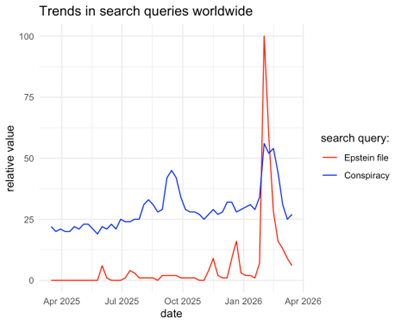
This parallel in search behaviour highlights the concurrent rise of these narratives, which may reinforce each other within the digital space.
An analysis of social media platforms like Instagram and TikTok reveals over 409K and 192K posts, respectively, with the hashtag #epsteinfiles. However, this figure only represents the tip of the iceberg, as posts about the Epstein files often omit the hashtag to avoid algorithmic penalties that deprioritize or penalize content related to controversial or sensitive topics. Despite these restrictions, highly engaging or sensational content can still achieve extensive reach through alternative mechanisms such as trending topics, comments, and shares; driven primarily by user interactions. This dynamic has the potential to amplify misinformation and conspiracy theories, making their prominence more a result of emotional engagement and algorithmic amplification than of factual accuracy.
Effects on three social levels
In light of the dynamics of social media, the confirmation of elements of the conspiracy theories surrounding Epstein’s network and activities, the ongoing but full access to the files, and the numerous unanswered questions regarding contextualization, we propose the following potential implications in three different segments of the public:
1) The Macro-Level Effect:
While the release of these files represents a legitimate and overdue act of democratic accountability, its societal effects cannot be assessed in isolation from the information environment in which it occurred. The presence of many high-ranking public and political figures in the files has the potential to intensify cynicism and criticism of current political systems and lead to questions about public officials’ accounts. Within the framework of dysfunctional theory, it can be assumed that political scandals generally have a negative impact on the political system, which is most likely linked to frustration and disappointment with democratic institutions. And while asking for accountability and system revisions to prevent that such activities and actions are not happening again, the accompanying rise in distrust and disillusionment could create an environment conducive to populist or radical movements.
2) The Meso-level Effect:
Members of the public who are already receptive to conspiracy theories will see their views confirmed by the contents of the files. This may be particularly true of communities that already sympathize with QAnon narratives. These communities interpret the extensive evidence as proof of a secret global paedophile ring protected by powerful elites potentially far exceeding the currently named high-ranked individuals. However, even individuals who hold different, unrelated conspiracy beliefs, such as chemtrail conspiracy theories or vaccine safety, are likely to view the Epstein files as corroborating evidence: They might argue that if the elite was involved in a cover-up to this extent in this instance that they have lied about other matters too. The belief, and in this case confirmation of one conspiracy theory thus potentially lowers the evidential threshold for accepting others, creating a feedback loop of generalized institutional suspicion. The Epstein files, given their unprecedented scale and the genuine culpability they reveal, represent a potent event to support such beliefs and particularly for QAnon-adjacent communities a high potential for political mobilization. Holders of less politically charged conspiracy beliefs may still experience a more diffuse but nonetheless significant erosion of institutional trust. And the distrust of institutions can undermine the quality of social relationships by eroding their core function of providing a shared sense of security and normative orientation. This weakens trust in strangers, reinforces prejudice and polarization, reduces community engagement and prosocial behaviour, and ultimately undermines interpersonal relationships within and between groups. Strong ingroup-outgroup segmentation provides a gateway through which extremist forces can spread their narratives.
3) The Micro-level Effect:
Ultimately, those who have completely turned their backs on belief in and support for democratic systems and institutions see an opportunity to exploit the dynamics after the release of the files for their own purposes. In this context, anti-Semitism is particularly prevalent, spreading under the guise of protecting vulnerable groups. The Initiative Democ, an association of journalists, scholars, and media designers, observed the frequent mention of anti-Semitic narratives regarding Epstein. They examined 55 postings that received a total of 114.4 million views, 6.7 million likes, and over 82,000 comments. All of the postings referred to Epstein’s Jewish heritage as the basis for their conspiratorial narratives. Contacts with Israelis are seen as proof that Epstein was a Mossad agent. The use of the Hebrew-Yiddish word “goyim” for non-Jews supposedly demonstrates his contempt for them. A bank account named “Baal”—after a Canaanite deity—is enough to link Epstein and Jews worldwide to Satanism. The most explicit posts also feature Nazi symbols and quotes from Hitler’s Mein Kampf. Such posts establish a causal link between Epstein’s background and his actions, which fuels anti-Semitism; a trend that 55% of people in the EU, for example, already view as a fairly significant or significant problem. This is not merely a discursive concern: anti-Semitic conspiracy narratives have served as the ideological basis to violent attacks in recent years. The propagation of such narratives in the wake of the Epstein file release therefore carries consequences that extend well beyond online discourse.
Ensuring genuine accountability emerges
What unites these three levels of effect is a structural mismatch: the files were released into an information environment that rewards speed and emotional salience over accuracy and context, meaning that the conditions for accountability and the conditions for radicalization were activated simultaneously.
To address these problems at least on the Micro and Meso-level, democratic institutions must take decisive action against perpetrators, provide support for victims, and commit to transparency. They must also develop mechanisms designed to prevent such activities in the future. Additionally, professional journalism is needed to contextualize the published documents, ensuring that free speculation and unfounded associations with the vast amount of information are curbed and genuine accountability emerges.
Brigitte Naderer is a researcher at the Center for Public Health, Medical University of Vienna. She is a communication scientist and her research focuses on online radicalization, persuasion, media literacy, and on (regulatory) approaches to counter harmful online content.
Image credit: Ahmadur Rahman on Unsplash