
By Human Digital
Introduction
Across the 10th and 11th September 2025, people seeking footage of the shooting of Charlie Kirk triggered a 110% increase in total visitor numbers to 21 gore sites (Figure 1). As detailed in Human Digital’s VOX-Pol report, Gore & Violent Extremism, those visitors will have been exposed to videos involving graphic violence, bloody war footage, extreme pornography, sexual abuse and acts of terrorism. This content presents psychological risks to young audiences and public safety risks from individuals with violence fascination.
The most severe consequence of these risks were present in November 2025, when more than 50 people were injured after a 17-year-old male student detonated an explosive at a school in Jakarta, Indonesia. The online activity of the teenager showed he held an interest in graphic violence and had interacted with Telegram groups glorifying white supremacist violence.
This blog provides data and analysis to support practitioners looking to understand how people access these sites, and can contribute evidence for government and industry efforts to disrupt entry points into the gore site ecosystem or consider exit strategies for individuals developing an interest in violent content.
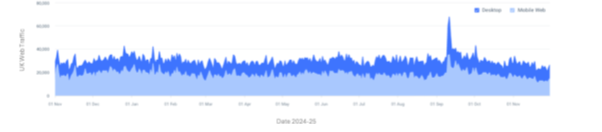
Figure 1: UK based Web Traffic to the 21 Gore sites Nov ’24 to Nov’25. Within the original Gore & Violent Extremism report this number was 24. 21 refers to the number of domains from within this initial list still active and visited across the designated time period.
What does the data show us?
Overall, the data highlights the accessibility of gore sites to young audiences and global interest in the services the sites provide (Figure 2). In July and August 2025, total global monthly traffic to the 21 sites showed a slight downward trend before the sudden increase. Importantly, the surge in web traffic on the 10th September occurred whilst graphic footage of Kirk’s murder was being shared across social media, and then subsequently dropped back to normal web traffic volumes by the 12th September to coincide with social media companies’ delayed moderation efforts. This suggests that removing content from social media did not have the negative effect of driving people to gore sites, whilst its availability on social media did not deter people from choosing to watch the footage on gore sites. This data reflects previous evidence, which showed how war footage – also available on social media – increased gore site traffic.
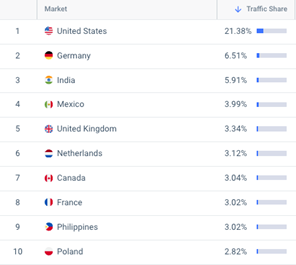
Figure 2: Top 10 Countries’ Traffic share to the 21 platforms
Prior to the shooting, one of the most globally visited gore sites averaged ~5,000unique daily visitors from the UK alone. On the day of the shooting, this rose to ~14,600 and contributed to a trend of increased traffic to the site. In response, the site reported that it had to temporarily go into ‘read-only’ mode “to handle the surge of traffic caused by Charlie Kirk’s tragic murder” and to disable new registrations due to “never-before-seen IMMENSE strain from traffic”.
Notably, analysis of referral traffic showed 37% of visitors to the most visited gore site had been on an adult site immediately before their visit, which could relate to studies into pathways between watching violent pornography and illegal content. Of particular concern was the presence of traffic from a forum discussing approaches to suicide, accounting for 15% of referral traffic to one of the most visited gore sites. This data is notable due to Com network members targeting victims within mental health communities online and their strategic use of violent content to coerce children into creating self-harm content.
Over the surge period, the average gore site visitor viewed ten pages per visit. This increases the likelihood of each visitor encountering a range of harmful material, often curated by the sites’ operators. Previous research identified over 12,000 examples of terrorist content across 24 gore sites, many presented within a ‘Terrorism’ sub-category, including both graphic and non-graphic propaganda produced by jihadist organisations such as Islamic State, and hundreds of uploads of the Christchurch, Buffalo, and Halle lone actor attack livestream videos. Given typical user behaviour, visitors are at significant risk of unintentional exposure to terrorist and ideological extremist content alongside the graphic material they may have initially sought out. At its most severe, consumption of gore and graphic violence, often from an early age, has been cited as contributing to individual radicalisation journeys in recent UK terrorism and school shooting cases e.g. Vincent Charlton (2024), Felix Winters (2025) and Nicholas Prosper (2025).
Who is visiting the sites?
Available demographic data indicates the average gore site visitor is male (82%), aged between 25 and 34. However, the userbase of the site most impacted by people searching for the Kirk footage differs from the others assessed, with the data suggesting 23% are female and most aged between 18 and 24. This may be a result of the site having a specific focus on crime and violent incidents, which converges with the true-crime community (TCC). According to studies, TCC over indexes on female consumption and, in South East Asia, is an emerging threat vector in attacks within 2025.
The relative youth of the visitors may be indicative of how users find the sites, with 51% accessing them directly e.g. clicking a link or typing in the URL, and 40% from search engines such as Google and Yandex. Importantly, 7.4% users are directed through social media platforms including Reddit, YouTube and X, and this figure was higher in September than any other month this year. This type of referral appears to divert larger percentages of young people compared with search and bookmark.
Why did people choose to visit gore sites to watch the footage?
A comprehensive understanding of the push and pull factors involved in encouraging a young person to view gore content has been and continues to be carried out by experts in psychology, such as Dr Rachel Worthington and Dr Chad Steel. Clinical psychology can inform understanding on violence fascination e.g. studies into morbid curiosity, or the application of existing models e.g. how conditions such as ADHD impact vulnerabilities in individuals seeking out and consuming harmful content online. In addition, it can help explain different audiences e.g. those clicking a link sent by a friend or family may have less psychological or environmental vulnerabilities than someone actively seeking out the gore site ecosystem. Importantly, these studies, when combined with the web traffic, ecosystem mapping and content analysis, can inform technical disruption opportunities and exit strategies for industry.
One popular gore site dedicated an entire thread to the shooting, which was continuously updated by website members as new details emerged. Alongside graphic footage of the incident, the thread hosted a substantial volume of non-gore material, including eyewitness accounts, media coverage, and lengthy text posts lifted from mainstream media outlets such as CNN. Once information about the alleged perpetrator became public, users uploaded images purportedly taken from the individual’s social media profiles and archived versions of associate webpages including the individuals Steam Community profile and posts, Discord username and ID and other related material. The thread functioned as a regularly updating community hub focused exclusively on the event and offered a centralised space through which users could rapidly obtain new information. This volume and frequency of content could feed into fears of missing out from young audiences or feed a desire to be the first to know news as it is shared. It is also symptomatic of how the most popular gore sites reflect the business model perfected by social media companies where instant gratification and validation is provided to a social network through functionality e.g. views, likes, upvotes, and comments.
Alongside the most visited gore sites, many of the 21 assessed sitesoperate as distinct online communities, enabling users to anonymously interact with posts in ways which resemble traditional social media. Users are able to up/down vote, comment and participate in polls on posts to the platform. For example, a dedicated thread on the Kirk shooting has become one of the most engaged posts on one popular site, with 2,688 comments, ranking 18th most popular overall and 2nd within the “shootings” sub thread (surpassed only by the Christchurch livestream). Ultimately, the sites provide a functional, anonymised space for collective discussion that may not have been available or socially acceptable elsewhere online.
Charlie Kirk’s notoriety and polarising public profile is likely to have a played a role in the web traffic surge, reflecting studies into how high-profile online influencers can generate parasocial relationships, both favourable and hostile, among audiences who have never interacted with them beyond the online space. This was reflected in the comment section and poll – “Did Charlie deserve this?” – hosted within the dedicated thread on one of the most popular sites. Users reactions ranged from sympathetic to celebratory, frequently challenging or supporting the views of others, and the poll received 5,820 responses (2,240 answered “yes” and 3,580 “no”).
What can be done to reduce the risk posed by gore sites?
Gore sites could be made to integrate age verification protections, similar to those enforced on some adult content sites in the UK. For web traffic referral, basic down-ranking is a useful solution for search engines and data-led mapping of the relationships between gore and other harms may present further opportunities for disruption e.g. adult content sites, suicide ideation and true crime community. Beyond that, gore-focussed hash-matching could be explored by social media platforms.
As the data has shown, high-profile violent incidents increase web traffic to gore sites, and in turn, this can present risks to young people and the wider public. Social media companies’ financial models depend on retaining the interest and engagement of children, purposefully creating algorithms that elevate high-engagement content and, in the process, promote harmful content that accrues views, comments, and interactions. It is possible that – alongside more consistent moderation of graphic violence – platforms promoting positive reinforcing content during surge events such as Charlie Kirk’s shooting could mitigate some of the curiosity of young people and disrupt the entry pathways to gore sites. Ultimately, this is likely to only occur if social media platforms are compelled by regulators or presented with a convincing business case for doing so.
Image credit: Daniel Romero on Unsplash
This blog was produced by researchers at Human Digital, a division within M+C Saatchi who develop data-led understanding and recommendations to combat online harms, including violent extremism, violence fixation, misinformation, and the exploitation of emergent technologies, for example generative AI, cryptocurrency and Web3. The team consists of analysts, data scientists and engineers working collaboratively with subject specialists from across academic disciplines. All Human Digital’s data collection, processing and analysis is facilitated by its secure and licensable technology platform, DeltaVision.