
By Bo Min Keum
First: why history?
Incel subculture did not start misogynistic or violent. This has been largely acknowledged. What’s less understood is how exactly celibacy came to be about misogyny and violence over time. Understanding this history matters today because it shows that radicalization is not a unilateral outcome of online platforms or celibacy itself. Incel communities developed through choices made by users who repurposed what celibacy came to mean: even as non-misogynistic, non-violent communities that existed alongside them.
So: how exactly did the Internet history of Incel communities evolve, and where did it diverge?
Data and Method
In another study, I interviewed a self-identified former Incel who had participated in Incel communities from the first one in 1997 until the mid-2010s. A key finding was the limited historical research on how Incel communities evolved over time.
To address this gap, I conducted an archival research. Archival research, however, has its challenges: archives can be incomplete, and (arguably) most importantly, historically relevant sites can seem irrelevant and risk being overlooked in research. Therefore, knowing what to look for is often the hardest part. The interviewee, having lived through this history, helped piece together four historical sites as interrelated, which they backed by archival evidence. I searched the Internet Archive and archive.today for the four sites and analyzed 232 archived webpage snapshots using thematic narrative analysis to explore what users discussed and how Internet affordances influenced cultural outcomes over time.
Involuntary Celibacy Project (1997)
In 1997, a self-identified lesbian woman started the “Involuntary Celibacy Project” mailing list and website, discussing celibacy as an inclusive, situational experience that could affect anyone, regardless of gender or personality —“whether you’re outgoing (like me) or shy,” “gay (like me) or straight.” The Project also likened The Incel Movement to the gay-rights movement: just as homosexuality had once been stigmatized, celibacy too was considered an experience often shamed in society. This contrasts with today’s misogynist Incel communities that normalize heteronormative and anti-LGBTQIA+ views.
Celibacy was also discussed as solvable. The “Making Changes” section shared the actions some members took to overcome their challenges. Being “ugly” was linked to learning self-acceptance, and feeling isolated was considered more introspectively in cultural and situational contexts, such as different family traditions of marriage. These discussions emphasize introspection and proactive problem-solving, which differ from today’s misogynist Incel communities that claim celibacy as biologically fixed and, in more extreme cases, rationalize suicide.
IncelSite(2004) and IncelSupport (2006)
The founder of the Project stopped maintaining the website in 1999. Visitors were redirected to IncelSite, which hosted the “Discussion and Support Forum” that carried on the earlier email-based exchanges of the 1997 mailing list, which they called “The Incel List”. IncelSite preserved the problem-solving orientation: “Success Stories” section featured members’ testimonials, such as one describing how sports and self-appreciation helped build confidence.
Over time, gendered dynamics began to develop, such as complaints that IncelSite was populated by women and debates on why shy men were rejected by women. IncelSupport created the 7 Sins: a community-made code of conduct aimed at keeping members accountable and discouraging discussions that weren’t helping anyone, or doing anyone good. IncelSupport also hosted a “IncelMyths” section to push back against ideas that women were to blame or that celibacy was a male-only experience.
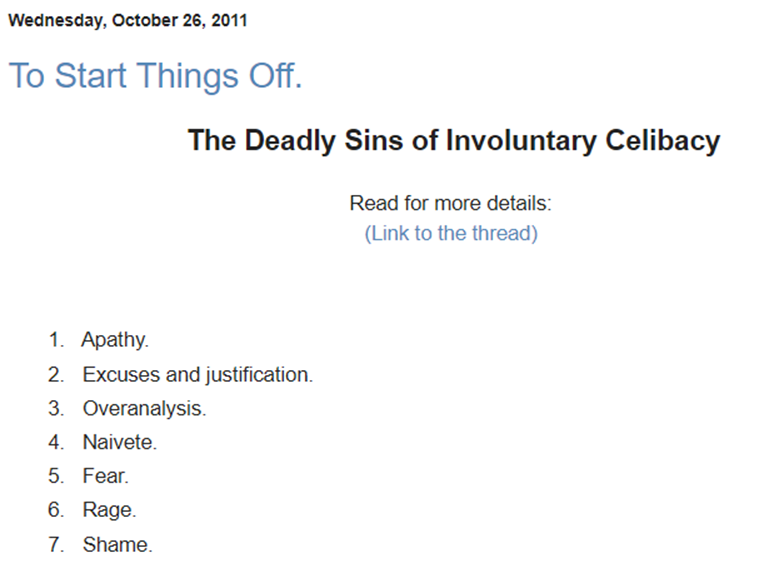
The 7 Sins and IncelMyths reflect not just rules but community practices that encouraged introspection about celibacy as a life circumstance and a set of challenges to be overcome, rather than a gendered grievance. This contrasts with today’s misogynist Incel communities, which police members for their “truecel” or “fakecel” status, or externalize blame by framing women as gatekeepers of sex.
Love-shy (2003)
Love-shy marked a divergence, particularly through how users came to define “love-shyness.” The term comes from the psychologist Brian Gilmartin’s 1987 book Shyness and Love, which profiled 300 virgin men. Early Love-shy discussions, like IncelSupport, treated love-shyness as a social difficulty to be addressed; In 2005, the Incel mailing list was shared as a possible source of support.
Over time, however, likely due to Gilmartin’s research only involving men, love-shyness was discussed as a heterosexual male experience. Its FAQ pages stated that the condition was “generally” not applicable to asexual or homosexual users and that “many men in the forum are frustrated with women”. Love-shy also tolerated misogyny and encouraged violence: a user claimed women deserved rape and another encouraged someone to buy a gun and kill his crush.
Love-shy and IncelSupport both began using similar early-2000s Internet affordances of web infrastructure: anonymous forums and threaded discussions. The over time difference was in users’ deliberation over how they negotiated what they wanted the forum to be about, through those affordances. IncelSupport had a more gender-inclusive membership, articulated shared expectations (7 Sins) and allowed space for challenging misogynistic explanations (IncelMyths). Love-shy, by contrast, closed off collective deliberation: their forum “guidelines” explicitly stated that “This forum is NOT A DEMOCRACY” and dissenting perspectives were pushed out. This allowed certain members to control which conversations were allowed and encouraged.
PUAHate (2009)
PUAHate extended this misogynistic and violent lineage. PUA’s idea of taking the “red pill,” originally a metaphor from the movie The Matrix, was reworked in the manosphere as an “awakening” to feminism’s alleged oppression of men. On PUAHate, celibacy was considered an outcome of women’s behaviour, and thus, mocked such “techniques” as meaningless attempts: ridiculing, for instance, dating advice as “mental masturbation.”
PUAHate showed little interest in addressing celibacy. Participation focused on provocation, and possibly, gamification. Forum features prominently displayed post counts and rankings, such as their “Boost” forum, which states: “Winning is not a sometime thing; it’s an all the time thing.” It is possible that mocking others – such as ranking members’ looks (e.g., “who is the UGLIEST PUAhate member ever?”) – enabled visibility metrics that incentivized hostility, reflective of the “gamification” phenomenon in online radicalization. Among the users was the 2014 Isla Vista perpetrator, whose posts encouraged others to “plot revenge”. After its shutdown, the lineage carried forward into contemporary Incel culture: as a user on Incels.is, now one of the most widely used Incel forums, described Love-shy as the “birthplace” of the incel culture and PUAHate as where it gained traction.
Discussion
Incel Internet history shows non-misogynistic Incel communities did exist, and were possible. Early Incel communities used similar Internet affordances to build gender-inclusive, introspective, and problem-solving cultures, while some repurposed celibacy to be about misogyny and promoted violence. In academia, this raises questions around data and methods. Focusing on misogynistic Incel communities risks studying those who are already in those environments (i.e. “dependent variable” problem). See, for instance, a 2019 survey by the founder of the 1997 Project (n=713) showing dating struggles across genders linked to life circumstances such as living with parents or conflicting work schedules. “NEET” was used as a situational descriptor (e.g., not employed, living at home) rather than the moralized term often used today, which implies refusing to engage in society. Research therefore requires greater focus on user agency and how people seek and sustain such norms. Contemporary counter-spaces such as r/IncelExit or r/ExRedPill could show how some, despite the shared celibacy experiences, do not turn to misogyny, or have begun to question misogynistic rationalizations. For policy, instead of “exceptionalizing Incels,” efforts should focus on redirecting the co-optation of misogyny, toward alternative pathways.
History shows that these alternative pathways can exist. Research and policy should focus on how choices can be redirected toward them.
Bo Min Keum is a PhD student in the School of Criminology and International CyberCrime Research Centre at Simon Fraser University.
Archival links are not provided here. If interested, please refer to the publication where you can see the archival data used for this study.