
Blog
What Does the ‘New Right’ Have to do With the Christchurch Attack? Some Evidence from Twitter on Discursive Overlaps
April 17, 2019By Reem Ahmed and Daniela Pisoiu In a globalized world, events thousands of miles away have far-reaching effects, mostly through their spectacularism. Oftentimes, these events feel even closer to home when there are ideas and people who might have in one way or another contributed to the facilitation of such atrocities. Right-wing extremism has long ...

Blog
Algorithmic Hate: Brenton Tarrant and the Dark Social Web
April 3, 2019By Luke Munn “From where did you receive/research/develop your beliefs? The Internet, of course.” ~ Brenton Tarrant On Friday, March 15th 2019, at 1:40pm, Brenton Tarrant walked into the first of two mosques in central Christchurch and began shooting indiscriminately, leading to the deaths of 50 people. Already there has been speculation about what drove ...

Blog
Philippines: The Black Flag Flies on Facebook
February 27, 2019By Nathan Shea The first news that militants had taken to the streets of the Islamic City of Marawi on May 23, 2017, came from Facebook. Pictures of masked men carrying assault rifles and waving the black flag of the Islamic State were swirling across social media well before Philippine and international news channels picked ...

Blog
Tracing Transnational Linkages on Twitter: Mapping Indian Diaspora Supporters of Brexit and Trump
February 20, 2019By Eviane Leidig A lacuna exists in the study of the radical right whereby researchers focus disproportionately on developments in Europe and North America. Yet, countries such as India, the Philippines, Turkey, and Brazil highlight how the radical right can operate, and indeed flourish, beyond the West. Our failure to incorporate these non-Western case studies poses ...

Blog
#Dundalk: Breaking News and the Far Right
January 2, 2019By Niamn Kirk, Eugenia Siapera, Gavan Titley Since ‘news tickers’ first began to crawl along the bottom of our television screens, ‘breaking news’ has become a key element in how audiences receive the news, and think about what counts as news. In a context where news stories now unfold rapidly across multiple media platforms, and an ...

Blog
Follow the Echo Chamber: Measuring Political Attitude Change and Media Effects on Twitter
October 10, 2018By Laura Jakli and Paul Gill This blog post summarises the preliminary results of a VOX-Pol supported study that estimates the effects of social media echo chambers on political polarisation. Social Media and Political Polarisation Countless news articles and studies argue that social media exacerbates political polarisation and distorts the political news landscape. The general argument put ...
Blog
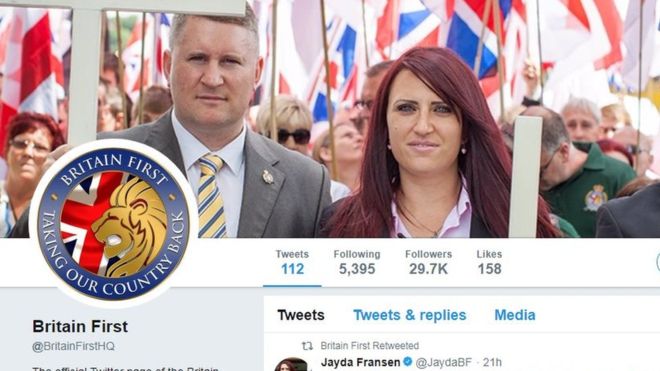
Account suspended: Twitter and extreme right-wing groups in the UK
December 20, 2017In December 2016, National Action became the first extreme right-wing group to be proscribed as a terrorist organisation in the UK. This, however, did not stop them from continuing their operations under new names, e.g. ‘Scottish Dawn’ and ‘NS131’, both of which were more recently banned by the Home Office. In a previous blog post, ...
News
VOX-Pol Participation in the Global Internet Forum to Counter Terrorism
December 5, 2017The Global Internet Forum to Counter Terrorism held an event this morning, 6 December 2017, at Google’s Brussels’ offices. The event featured representatives from GIFCT founder companies, Google, Facebook, Microsoft, and Twitter, along with the EU Commission, EUROPOL, ICT4Peace, CDT, and others. The first panel discussion and Q&A included stakeholders from agencies engaged in the ...
Blog
Industry Efforts to Censor Pro-Terrorism Online Content Pose Risks to Free Speech
October 11, 2017By Sophia Cope, Jillian C. York, and Jeremy Gillula In recent months, social media platforms—under pressure from a number of governments—have adopted new policies and practices to remove content that promotes terrorism. As the Guardian reported, these policies are typically carried out by low-paid contractors (or, in the case of YouTube, volunteers) and with little to ...
Blog
Wilayat Internet: Islamic State’s Resilience Across the Internet and Social Media
October 4, 2017By Laurence Bindner, Raphael Gluck This article was originally published in French on Ultima Ratio. Since partly going underground in the deep-web, ISIS exerts continuous pressure to make its propaganda surface on the public web. Adapting constantly to ever more active censorship, ISIS uses the various web platforms in an opportunistic and agile way. Therefore, ...