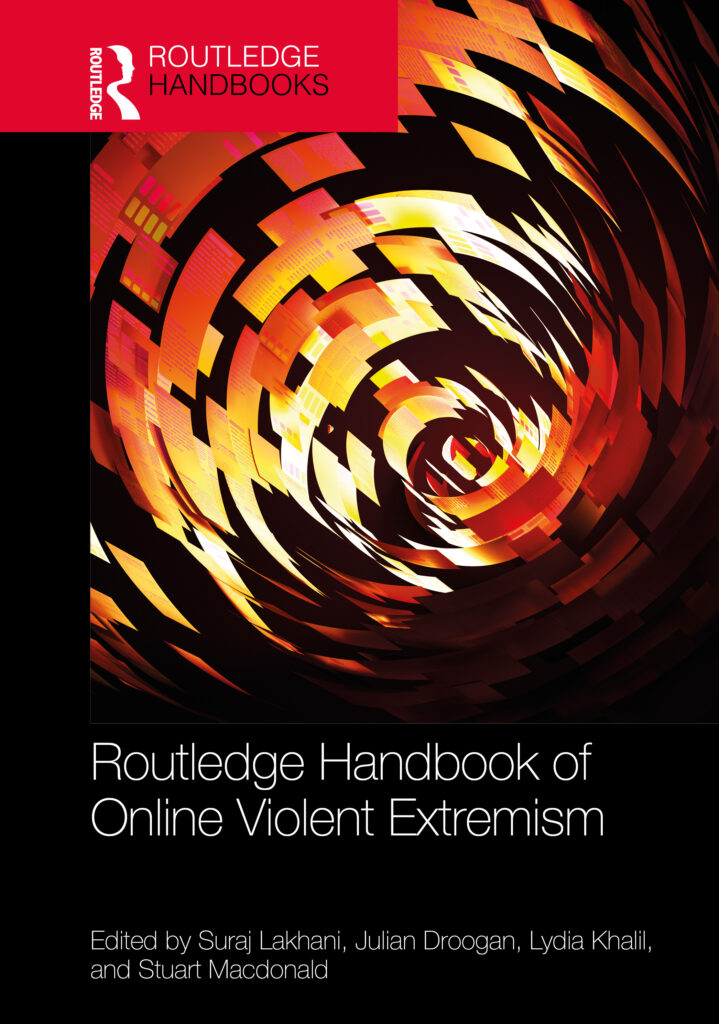
VOX-Pol hosted an international launch webinar to mark the publication of the Routledge Handbook of Online Violent Extremism. The event brought together co-editors and contributing authors to discuss the key findings, methodologies, and critical policy implications outlined in this comprehensive reference work. Co-edited by Dr. Suraj Lakhani (University of Sussex), Prof. Stuart Macdonald (Swansea University), Dr. Julian Droogan (Macquarie University), and Lydia Khalil (Lowy Institute), the handbook represents a major milestone in mapping the evolving landscape of digital radicalisation, extremist ecosystems, and counter-responses.
Mapping a Fragmented and Rapidly Evolving Field
In his opening presentation, lead editor Dr. Suraj Lakhani outlined the scope and underlying philosophy of the 40-chapter volume. The handbook is structured across four core thematic parts:
- Concepts and Counter-Responses: Core definitions of online terrorism and radicalisation, alongside P/CVE interventions, regulatory frameworks, and tech sector content moderation.
- Research Design, Methodologies, and Ethics: Guidelines covering netnography, visual analysis, intersectionality, data security, and researcher well-being.
- Online Spaces and Emerging Technologies: Examination of mainstream platforms, messaging apps, gaming spaces, alt-tech forums, generative AI, immersive technologies, and algorithmic recommendation engines.
- Ideologies, Actors, and Subcultures: Analysis spanning jihadist networks, extreme right-wing movements, underrepresented ideologies (such as Hindu and Buddhist extremist currents), apocalyptic violent extremism, misogynistic incels, and the manosphere.
Dr. Lakhani emphasised that a central goal of the volume was bridging academic research with policy and practitioner needs, while intentionally pairing established leaders in the field with early-career researchers.
Panel Highlights and Author Contributions
The webinar featured detailed presentations from several chapter authors, each offering a window into their contributions:
- Typology of Online Spaces: J.M. Berger presented his framework for categorising digital platforms based on access parameters (closed, gated, and public) and primary activity types (broadcasting, recruitment/confrontation, fundraising, and identity construction).
- Social Media Affordances & Historical Periodization: Prof. Maura Conway (Dublin City University & Swansea University) discussed applying media and communication theories to examine social media evolution. She detailed a three-phase timeline spanning the permissive/participatory era (2006–2015), the disruption and deplatforming period (2016–2022), and the recent tech retrenchment and regulatory expansion phase (2023–present).
- Netnographic Methodologies: Dr. Jonathan Collins (Charles University / VOX-Pol NextGen Network) introduced netnography as an accessible qualitative method for capturing rich, reflexive insights into online subcultures, drawing on his empirical study of connection-making behaviours within neo-Nazi groups on Gab.
- Gender, Power, and Propaganda: Dr. Elizabeth Pearson (Royal Holloway, University of London) highlighted the distinction between sex and gender in extremist research. She illustrated how gender dynamics shape ideology, visual propaganda, and organizational legitimacy across far-right and jihadist ecosystems.
Watch the Full Webinar Recording
The session concluded with an interactive Q&A session addressing audience questions on methodological ethics, platform ownership, and long-term research trends. For those who were unable to attend live, the complete webinar recording is available to watch on the official VOX-Pol YouTube Channel.