
Welcome to Volume 13, Issue 9 of the monthly VOX-Pol Newsletter
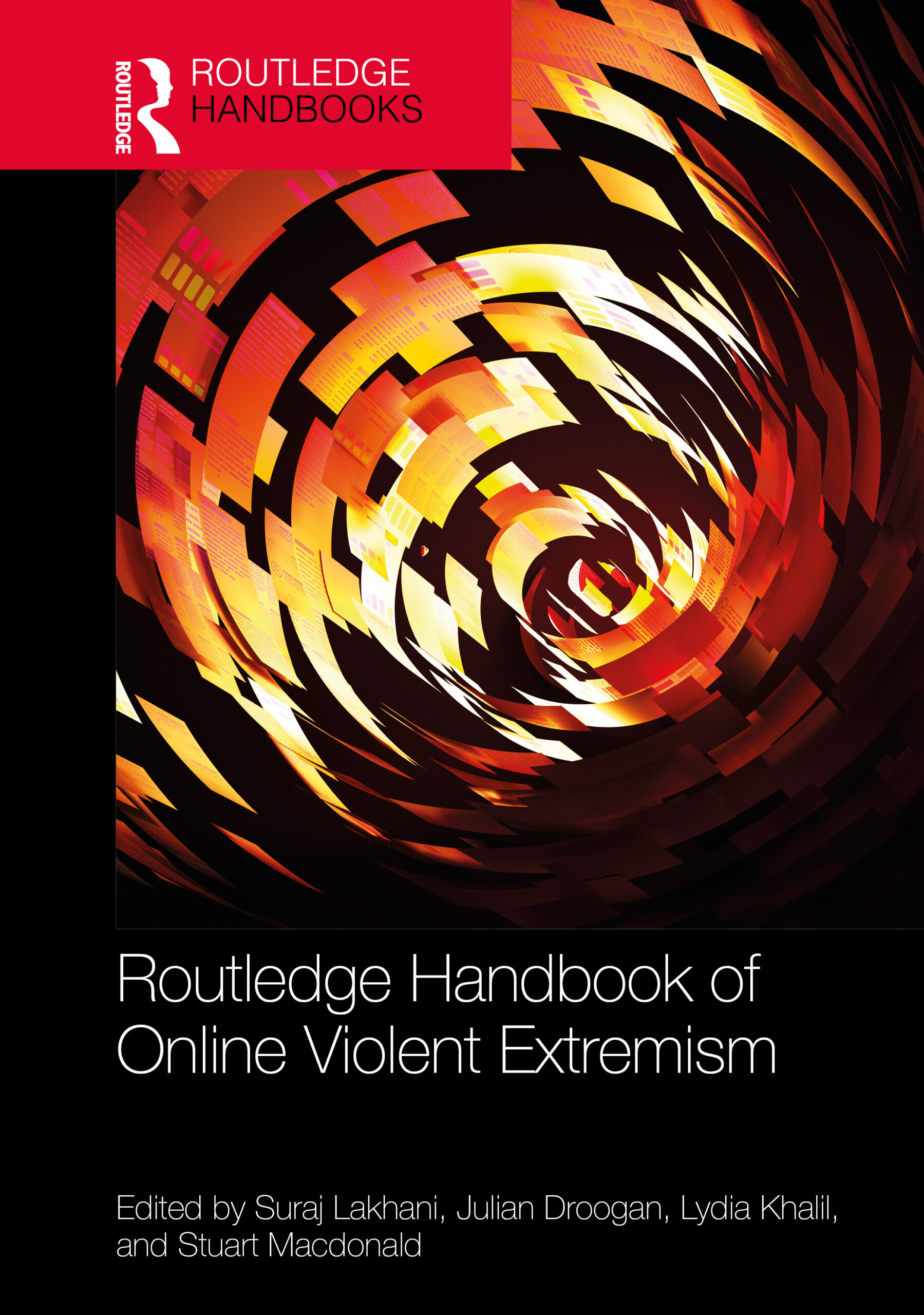
The Routledge Handbook of Online Violent Extremism
We are very pleased to announce that Routledge is publishing the Handbook of Online Violent Extremism on 29th September and is available to pre-order now. The Handbook is edited by Suraj Lakhani (University of Sussex), Stuart Macdonald (Swansea University), Julian Droogan (Macquarie University), and Lydia Khalil (Deakin University). The volume, running to around 40 chapters and drawing on more than 50 contributors, grew out of the collective effort of the VOX-Pol network, bringing together researchers who have built and sustained the study of online violent extremism as a field over the past decade. In particular, we want to acknowledge the tireless work of Associate Professor Suraj Lakhani in leading this project.
The Handbook is intended as the first comprehensive reference work mapping both the problem of online violent extremism and the range of responses being developed to counter it, and as a foundation for an emerging area of study sitting at the intersection of terrorism studies, computer science, law, sociology, and criminology. Chapters address contested definitions of terrorism, extremism, and radicalisation; the reach and limits of platform regulation and content moderation, including GIFCT’s cross-platform initiatives; evidence for and against algorithmic radicalisation; and generative AI’s dual role in producing extremist propaganda and supporting counter-extremism efforts. Further chapters cover immersive technologies, gamification, nihilistic and apocalyptic online subcultures, accelerationism, ecofascism, incel communities, and gender dynamics in radicalisation. Case studies range from al-Qaeda and Islamic State to Al Shabaab and Boko Haram, Hindutva-linked digital agitation in India, the online lead-up to Myanmar’s Rohingya genocide, and disinformation surrounding Brazil’s 2022 election. The Handbook (ISBN 9781003517917) is available in hardback and as an E-book from Routledge. For more information, including a list of chapters and abstracts, and to pre-order, visit here.
Upcoming Event: VOX-Pol Next Generation Network Conference
We are pleased to announce the 2nd annual VOX-Pol Next Generation Network Conference. The conference will be held on December 1st-2nd, 2026 at Charles University in Prague, Czech Republic.
This interdisciplinary event provides a unique opportunity for PhD students, postdoctoral researchers, and other ECRs to share their work, receive constructive feedback, and network with peers and established scholars in the field. We welcome contributions from a broad range of disciplines related to violent online extremism, including (but not limited to): media and communication studies, political science, law, psychology, sociology, criminology, international relations, computer science, and digital humanities.
Conference Theme
The conference will explore broadly-defined contemporary challenges in online extremism research, including the evolution of extremist narratives, platform governance, algorithmic amplification, cross-platform strategies, and any other key socio-technical dynamics.
This event is organised under VOX-Pol and the VOX-Pol Next Generation Network, a community dedicated to supporting early-career researchers working on issues related to online extremism. As part of the wider VOX-Pol research network, the conference will also feature the participation of senior scholars in the field, who will provide commentary and constructive feedback on ECR presentations, helping to foster dialogue across career stages and disciplines.
Awards and Grants
Bo Min Keum (PhD student, Simon Fraser University) has been awarded an Ernst Mach Grant for a research project and four-month research stay at the Medical University of Vienna’s Centre for Public Health, where she will be hosted by and work with Brigitte Naderer (Tenure-track Senior Researcher, Medical University of Vienna). Together, they will examine what makes counterspeech effective in reducing young men’s susceptibility to manosphere narratives, using a pre- and post-test factorial experimental design to test whether effectiveness depends on message framing (prospective gains or losses) and speaker identity (men or women).
VOX-Pol Member Publications
James Fitzgerald, together with NetLab UFRJ colleagues Debora Salles and Rose Marie Santini co-authored Of Politics and Playbooks: Silencing disinformation research(ers) in times of autocracy in Journalism History. The article forms part of a special issue, which will launch on 2 October at Columbia University.
The VOX-Pol Blog: The Top 4 Most Read Blogposts of the Year
Every year in August, we take stock of which were the most read amongst the blog posts published over the past year.
The top 4 blogs this year were:
1. Our most read post of the year is “Use of Coded Language by Far-Right Extremists Online: Emojis, Numbers, and Symbols Reinforce In-Group Identity” by Francesca G. (Centre for Information Resilience) and Isabella Gomez-O’Keefe (The University of Cambridge) in which they explore how far-right extremists use coded language and dog-whistles on TikTok to evade content moderation and build community.
2. Another widely read post was “Visits to Gore Sites Driven by Searches for Graphic Footage of Charlie Kirk’s Death” by the team at Human Digital. This blog post examines how high-profile violent events drive massive traffic spikes to online “gore” sites, using the September 2025 shooting of Charlie Kirk as a primary case study.
3. The third most read blog post this year was “The Hide-and-Seek Champion: Conspiracist Reactions to the Porepunkah Shootings” by independent researcher Gerard Gill in which he analyzes how Australian online conspiracist communities reacted to the August 2025 Porepunkah shootings.
4. Ryan Ratnam’s (Centre for Countering Digital Hate) “Short-Form Violent Content and Pathways to Fringe Gore” was the fourth most read blogpost this year, exploring how mainstream short-form video features (such as Instagram Reels, YouTube Shorts, and TikTok) expose users to graphic violence and serve as pathways to fringe gore spaces like Telegram.
Are you interested in publishing a VOX-Pol Blog post? Read our Blog submission instructions here.
VOX-Pol is on Bluesky. Follow us for updates @vox-pol.bsky.social.
And find us on LinkedIn @VOX-Pol.