By Kamil Yilmaz
In April 2026, Türkiye was shaken by two unprecedented school shootings in the country’s southeastern region. The first attack was carried out on April 14 by Ömer Ket, a 19-year-old former student at Ahmet Koyuncu Vocational and Technical Anatolian High School in Siverek, Şanlıurfa, who injured 16 people before dying by suicide. The second attack took place on April 15, when 14-year-old eighth-grade student İsa Aras Mersinli opened fire at Ayser Çalık Secondary School in Kahramanmaraş, killing nine people and injuring 13 others before dying from severe blood loss following a stab wound to the leg inflicted by a parent.
Although Turkish society has long been exposed to different forms of violence—such as terrorism, domestic abuse, organized crime, and so-called “honor killings”—these incidents still came as a shock to both the public and officials, largely due to the country’s stringent gun regulations, which require licensing, registration, mental health evaluations, and criminal background checks, along with severe penalties for illegal possession. Both attacks appear to have been preventable, as they were not sudden, impulsive acts but rather the product of malice aforethought and prior planning. While numerous offline warning signs fall outside the scope of this article, the perpetrators’ online activity alone provides substantial evidence that the attacks were premeditated. In a nutshell, before carrying out the attacks, both individuals exchanged threatening messages online and were deeply engaged in gaming cultures characterized by violent themes and characters, while the second perpetrator also exhibited influence from incel ideology.
Emulating School Shooters
The Siverek attacker’s motivation was assessed as resentment over truancy and being expelled from school. Experts have suggested that Ket blamed his school management for his educational failures and harbored resentment for them. His online activity showed a preoccupation with the 1999 Columbine High School massacre and “copycat” content, which led investigators to believe that he was motivated by a desire to emulate global school shooters. He had in fact been detained and released just one day before the attack after sending explicit threats to the school on his social media accounts: “Get ready, there will be an attack at this school in a few days” and “See you tomorrow — I will destroy all of you.”
Influence from incel ideology
The most conspicuous sign from the second attacker, Mersinli, was his association with inceldom, as his WhatsApp profile picture depicted Elliot Rodger, a misogynistic mass killer who carried out a stabbing and shooting attack in Isla Vista, California, in May 2014 and has since been idolized in some incel communities (See Figure 1 below). In addition, reports indicate that his Steam profile included messages suggesting he had spent thousands of hours on gaming platforms and titles such as Counter-Strike 2, Roblox (currently banned in Türkiye), and Discord.
Following the shooting, a manifesto began to circulate on social media, which was allegedly written by Mersinli and published in his Discord profile. In it, Mersinli wrote, “As of writing this, it is April 11th, 2026. By the time you are reading this, I am either in planning to do something big, have done something big or about to do something big.” The document also reportedly contained remarks in which Mersinli expressed a desire to be “noticed” and described himself as “intelligence-wise better than everyone around me.” The document was later circulated on social media after being leaked by an individual from Argentina who, in a video, claimed to have been Mersinli’s girlfriend and stated that he was non-binary She also stated that Mersinli had allegedly expressed intentions to carry out such an attack, but they believed he was joking at the time.
Furthermore, several hours before the attack, Mersinli reportedly posted a message in a Discord group chat stating that he might carry out the attack “today (April 15) around 3 p.m. or so,” along with additional details including his familial problems and psychological state. Mersinli had also expressed an interest in firearms to his father, the retired police chief Uğur Mersinli, asking him why he would not teach him how to use a gun. Uğur Mersinli was later taken into custody, and in his police statement he said that just a few days before the attack, he had taken his son to a shooting range to teach him “target shooting.” According to him, the purpose of this was to “dampen his enthusiasm” for weapons.
In addition, the parents were aware of their son’s psychological issues, as they had arranged psychiatric treatment that lasted for two months; however, he did not continue with it. They also stated that their son was introverted, often spending hours in his room in solitude, playing computer games and communicating in English with foreigners on the internet, which they did not fully understand.
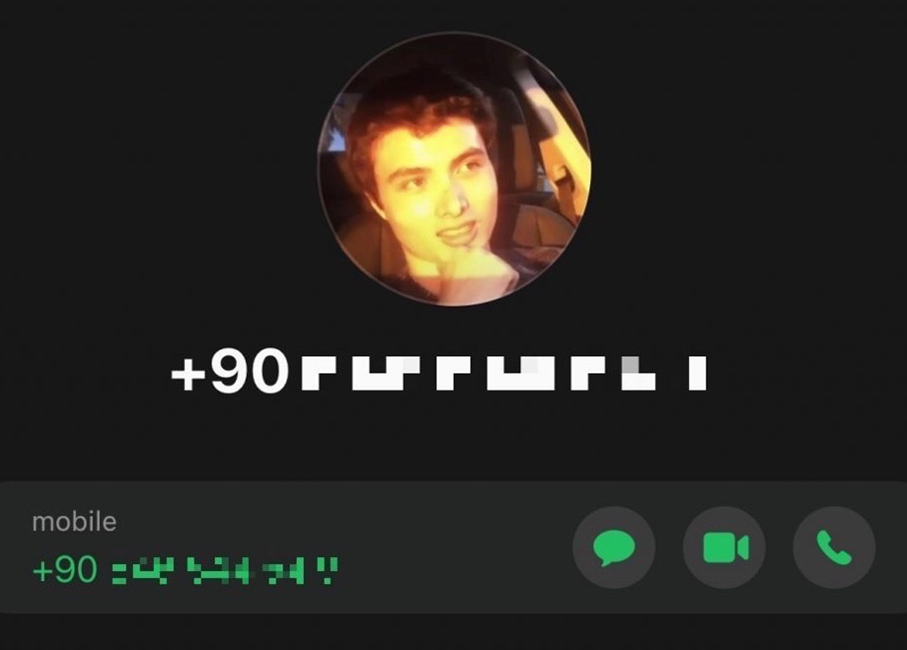
Figure 1 – WhatsApp profile of the Maras school shooter, Mersinli, with Elliot Rodger as profile image
The Broader Significance of These Two Cases
The importance of these two cases is multifaceted. The first concerns with the visibility of escalation in online behavior and the predictability of intent. Both cases demonstrate that the attackers did not act impulsively, but gradually revealed intent through online threats, expressions of discontent and symbolic references. Their digital footprints indicate that violent intent can often be traced in advance when online behavior and signs are contextualized properly.
Second, and closely related to the above, these cases underscore the importance of digital literacy programs and awareness campaigns aimed at helping individuals understand extremist ideologies and their symbolic and communicative cues. Recognizing such indicators in online behavior is essential for identifying early warning signs and understanding how harmful intent may be communicated indirectly through digital spaces. For example, had Mersinli’s parents questioned the presence of Elliot Rodger’s image on his WhatsApp profile and conducted appropriate follow-up, they might have been able to take steps that could have helped prevent potential harm involving their son. Similarly, if Mersinli’s Argentinian friends had been more aware of the risks associated with the connection between expressing malicious intent and acting on it, they might have reported it to the Turkish authorities, potentially preventing harm to their friends and others.
Finally, these cases show the convergence of online subcultures with violent framing and radicalization pathways. They highlight how different online environments—gaming platforms, anonymous chat spaces, and extremist subcultures—can intersect in shaping narratives of grievance, identity, and imitation. In particular, the blending of school shooter “copycat” culture and incel-related ideology illustrates how global violent subcultures circulate online and are reinterpreted in local contexts. Relatedly, the Kahramanmaraş attack marks the second incel-related incident in Türkiye, following the brutal 2024 murders of two women in Istanbul by Semih Çelik. This points to the need for incel-related violence to be taken more seriously in the Turkish context, while also encouraging researchers to examine inceldom beyond Western settings.
Dr. Yilmaz is a Lecturer in Criminology, Sociology, and Social Policy at Swansea University & a Senior Research Fellow at Artis International.
Image credit: Photo by Souro Souvik on Unsplash