By Joshua Farrell-Molloy
Only a decade ago, Ireland’s far right was barely visible. Its current form is rooted in 1990s anti-abortion activism, which shaped the political careers of figures Justin Barrett and James Reynolds, who in 2016 co-founded the National Party, Ireland’s largest far-right party. The 2018 abortion referendum provided an early incubation space for the movement, bringing initial networks together, while it flourished during the COVID-19 pandemic, as anti-lockdown grievances fuelled the growth of an Irish far-right ecosystem.
In 2022, the movement easily latched onto localised anti-immigration protests with a “house the Irish first” narrative. Demonstrations spread nationwide in response to the placing of asylum seekers in emergency accommodation centres during a period marked by a national housing crisis and an influx of Ukrainian refugees. The protests were a turning point. Since they began, the number of influencers, groups and parties has grown. A distinct Irish far-right ideology has further crystallised, which draws on historical symbols, narratives and aesthetics from Ireland’s republican past.
This rootedness in national history was evidenced in early-December, when a video spread on social media, purportedly from a newly formed anti-immigrant dissident republican group in Northern Ireland, the “New Republican Movement”. In the footage, three men in balaclavas stood in front of an Irish tricolour flag armed with what appeared to be firearms. A speaker, who introduced the group as “proud men of Ireland” and “patriots”, declared their opposition to immigration, before threatening elected representatives: “We have your addresses and know your movements, every one of you are legitimate targets as of today.”
In another incident only weeks earlier, two men belonging to the “Irish Defence Army”, who intended to attack mosques and asylum seeker accommodation, were charged with possession of explosives. Like the New Republican Movement, the Irish Defence Army recorded a video. Wearing balaclavas in front of a tricolour flag, members delivered an anti-immigration statement before claiming responsibility for upcoming intended attacks.
While investigations are ongoing in each case, what is clear is that in both videos, through flags, masks, and choreography, there is a conscious mimicry of Irish republican paramilitary aesthetics typically associated with groups active during the conflict in Northern Ireland (1969-1998), like the Provisional Irish Republican Army (PIRA), or factions active in the dissident Irish republican campaign (1994–ongoing). Such performances represent an indigenised form of militant masculinity rooted in Ireland’s republican tradition of militancy.
Yet, much commentary and research on the Irish far-right focuses instead on transnational elements, such as connections to overseas actors, engagement with global far-right narratives or conspiracy theories. This distracts from the more significant emergence of a home-grown ideological project driven by politically maturing Irish groups, who nativise far-right ideology by embedding it in historical Irish nationalism.
Irish nationalism, martyrdom and masculinity
To understand the phenomenon of a home-grown Irish far-right, it is necessary to understand the relationship between masculinity and Irish nationalism. As historian Aidan Beatty points out, masculinity was central to nationalist politics, with an Irish manhood constructed in opposition to British racialised stereotypes and caricatures depicting the Irish as inferior and primitive. In response to the humiliating experience of colonial domination, nationalists projected an ideal of the proud Gaelic warrior as a means of restoring dignity.
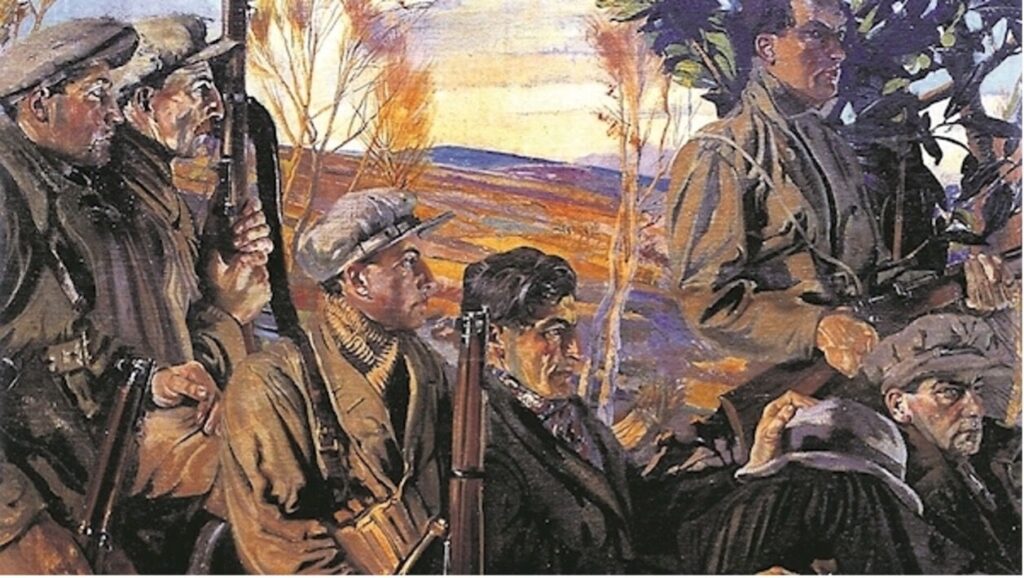
This was especially pronounced during the Gaelic Revival. Cultural nationalism emphasised physical strength, discipline and virility as markers of Irish manhood, promoted through institutions such as the Gaelic Athletic Association and reinforced by mythological figures like Fionn Mac Cumhaill and Cúchulainn. From these cultural foundations emerged a political ideal linking the bearing of arms to honour, in which the Irish Volunteers and later the IRA, came to embody masculine virtues of courage, self-control and discipline, an image perhaps best captured in Seán Keating’s iconic painting of heroic IRA figures in Men of the South.
Martyrdom for Ireland was upheld as the highest example of masculine heroism. The commemoration of patriot dead framed sacrifice as a generational struggle, in which each failed uprising inherited the legacy of the last and, in turn, inspired the next. This narrative gained renewed potency after the Easter Rising of 1916, which rebellion leader Patrick Pearse in his proclamation explicitly situated within this lineage of armed rebellion, stretching from the 1641 rebellion through 1798 to the Fenian rising of 1867. As writings of so many involved in the Rising and the War of Independence attest, history was central to how they understood their actions, instilling a deeply felt sense of continuity, duty and belonging that continues to resonate within Irish republicanism.
Reanimation by the far right
Contemporary Irish far-right actors reanimate these very same cultural scripts, historical narratives and masculine ideals, by performing a disciplined, militarised masculinity that draws on a long republican repertoire, echoing the commitment of the Irish Volunteers or disciplined PIRA flag-bearers. They redeploy the familiar generational call to manhood, fusing their ideology with the struggle for Irish independence by framing their mobilisation as a continuation of earlier national struggles. Through this lens, far-right activism is cast as a masculine duty owed to Ireland.
This dynamic is visible in the online content of several groups. One video on Telegram of a National Party member delivering a fiery speech is set to a phonk-style instrumental track and interspersed with rapid-fire flashes of Easter Rising leaders and armed PIRA members, projecting a stylised performance of militant, masculine national pride. Neo-Nazi organisation Clann Éireann, formed after a split from the National Party, makes use of imagery associated with the 1798 rebellion in their propaganda, such as the ‘pikeman’ statue, representing an iconic rebel figure of the uprising armed with a pike, channelling the defiant legacy of 1798 to their own cause against mass immigration.
The Irish chapter of the Active Club network, Comhaltas na nGaedheal invokes 1916 in recruitment posters, and frames their activism as masculine duty in continuity with the same cause, a theme encapsulated in a three-image post from an affiliated Telegram channel, featuring IRA gunmen from the 1920s, camouflaged PIRA figures from the 1990’s, and Comhaltas members, captioned “Different eras, same struggle”. In each representation, historic Irish struggles are repurposed in opposition to immigration, with masculinity functioning as the glue that fuses past and present into a single narrative, depicting activists as standing up and embracing the duty of national defence.
A militarised masculinity is also performed in choreographed settings. Clann Éireann’s inaugural speech by group leader ‘Ceannaire’ Justin Barrett, was delivered in front of members wearing berets over balaclavas standing in disciplined formation. This beret-over-balaclava aesthetic mirrors the visual language of PIRA statements and commemorations during the conflict in Northern Ireland, signalling perceived continuity with a recognisable tradition of disciplined militant republican masculinity. More recently, the group has adopted a greenshirt-style uniform, invoking the paramilitary wing of the fascist National Corporate Party.
Through these performances as disciplined protectors of the nation, Clann Éireann resembles what scholar Elizabeth Pearson observed in the protest culture of far-right group Britain First, whose adoption of uniforms, marching, and displays of discipline, enabled activists to assume a valorised masculine identity through activism. While Pearson focused on the British far right, Irish groups like Clann Éireann localise these same rituals, embedding them within Irish historical narratives and republican symbolism to position themselves as guardians of the nation.
Emasculation and boundary policing
Another central feature of this masculine project is the subordination of perceived rivals. Sinn Féin, historically the political wing of the Irish republican movement and closely associated with PIRA, along with many dissident republican groups opposed to the peace process, adhere to left-wing ideologies. These groups are subsequently portrayed by the far-right as weak and emasculated, accused of abandoning the Irish struggle in favour of ‘marxism’, and no longer competent to defend Irish sovereignty. Clann Éireann-affiliated group Republicans Against Antifa has this mission at its core, targeting left-wing republicans with graffiti and vandalism, while distributing propaganda, often in republican heartlands in Northern Ireland.
This notion of masculinity as authenticity also structured how the far-right responds to British or loyalist involvement in Irish protests. Irish activists who openly embrace such alliances tend to be politically immature, whereas groups anchored to identitarian or neo-Nazi ideologies in Ireland instead engage in active boundary policing, distancing themselves from such individuals and performatively condemning any engagement. Rejecting collaboration becomes a way of reasserting Irish nationalist authenticity and masculine credibility from the humiliation and emasculation of collaborating with historical oppressors.
Conclusion
The cases of the New Republican Movement and the Irish Defence Army illustrate how deeply rooted the contemporary Irish far-right is in local historical and political culture. Rather than relying solely on imported conspiracy theories or global narratives, the Irish far-right more broadly draws upon a long-standing repertoire of nationalist and republican symbolism, giving the movement cultural resonance and potentially greater staying power.
Masculinity functions as an ideological scaffolding for the Irish far right. Actors portray themselves as disciplined protectors of the nation, invoking a militant lineage rooted in sacrifice, generational duty and revolutionary continuity stretching from 1916 through to 1798 and beyond, while fear of emasculation informs their rivalry with other republican actors or the rejection of loyalist alliances. Rather than fixating on external influences or short-term symbolic convergences that may seem surprising, greater attention should be paid to the deeper ideological groundwork and identity-formation shaping the Irish far right’s long-term trajectory.
This blog was first published in RightNow!, Center for Research on Extremism, University of Oslo
Joshua Farrell-Molloy is a PhD student at the Department of Global Political Studies at Malmö University. His doctoral project focuses on digital subcultures and is part of the EU-funded Marie Skłodowska-Curie ‘VORTEX’ Doctoral Network, which focuses on developing new evidence-based innovative strategies to counter and prevent ideological and behavioural radicalisation.
Image: Men of the South by Seán Keating (1921)